
Nigerian Blackmail: What to Do If You Are the Target
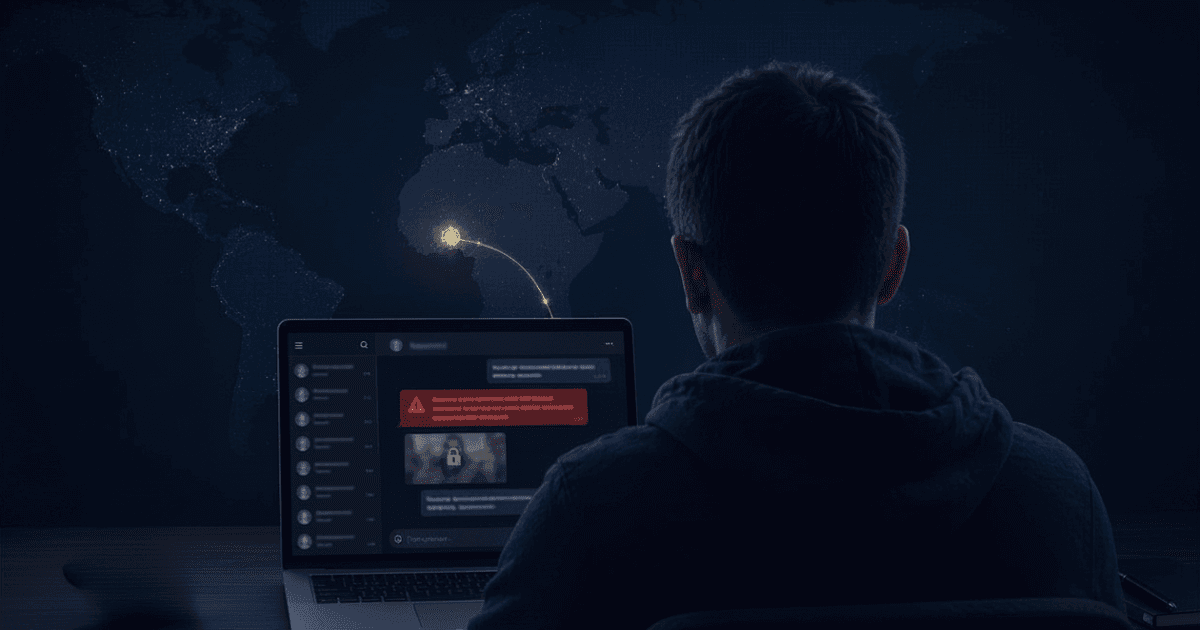
Nigerian blackmail cases follow a specific operational template that developed over two decades and continues to produce thousands of active cases each month. Understanding the template is the fastest way to identify what you are dealing with and choose the right response. The attackers are rarely solo criminals; most operate as coordinated cells that share targets, tactics, and money-transfer infrastructure across multiple victims at once. This guide covers what to do if you are the target of Nigerian blackmail, from recognizing the pattern through immediate response, cross-border reporting, and content removal.
Understand How Nigerian Blackmail Works
The signature of Nigerian blackmail is not the specific claim but the operational structure behind it. Attackers work in teams, share victim lists, and move money through recognizable channels.
The Contact-to-Escalation Pattern
Initial contact almost always happens on social media, typically Instagram, Facebook, or a dating app, using a stolen profile photo and a persona designed to appeal to a specific demographic. Conversation moves to WhatsApp or another messenger within days, then to a video call where compromising material is captured. Once material exists, the attacker introduces urgency: a fake family emergency, a fake medical bill, a claim they are stranded. Demands escalate from small amounts to large sums, and if the target refuses, the threat pivots to public exposure, sharing content with family, employer, or social contacts scraped from the victim's profile.
The Money Transfer Trail
Payment demands run through cryptocurrency, gift-card codes, or MoneyGram/Western Union transfers routed through named individuals in Lagos, Port Harcourt, or Ibadan. The named recipients are often low-level members of the cell whose accounts are used to launder proceeds.
Immediate Response in the First Hour
The most damaging errors happen fast. What you do in the first hour usually determines the resolution.
Do Not Pay or Respond
Payment is treated as an admission that the target is viable; cells share paying-victim lists across operators, meaning a single payment produces new demands from other attackers who purchased or copied your identifier. Every reply, even one refusing to pay, feeds the operator information about your emotional state, your negotiation posture, and your fear threshold. Silence combined with non-payment is the strongest signal you can send.
Preserve Everything Before Blocking
Screenshot the attacker's profile, all messages, any threats, and any payment demand details including exact wallet addresses, MoneyGram receiver names, or bank routing information. Save timestamps before you block, since many messaging apps remove message history the moment you block, permanently destroying evidence.
Reduce Your Attack Surface
Lock down friends lists, followers lists, and tagged photos across every platform; the attacker's contact list of your family and friends came from your public profile, and attackers who lose contact-list access lose a major part of their leverage. If the attacker got in via a video call recorded on a specific messenger, treat that account as compromised: rotate the password, review linked devices, and enable two-factor authentication on the account and its recovery email.
Lock Down Social Media Privacy
The attacker's contact list of your family and friends came from your public profile. Lock down friends lists, followers lists, and tagged photos across every platform. Attackers who lose contact-list access lose a major part of their leverage.
Change Payment Methods If Any Exchange Occurred
If you already paid, cancel the card or account used, notify your bank of the fraud, and request a chargeback where available. Cryptocurrency payments are typically not reversible, but bank transfers and gift-card purchases sometimes are if reported within hours.
Need Expert Help?
Our team has resolved thousands of cases. Get confidential support now.
Report to Multiple Jurisdictions
Nigerian blackmail is inherently cross-border, and the same logic applies to anyone being blackmailed from another country, regardless of which one. Reports at every level increase the probability of investigation and eventual disruption.
File With FBI IC3
The FBI Internet Crime Complaint Center (IC3) coordinates with international partners including Interpol on Nigerian cybercrime. Include the attacker's payment addresses, receiver names, and any phone numbers, since cluster analysis on these fields is how operators are identified.
Report to Nigerian and Local Authorities
The Nigerian Economic and Financial Crimes Commission (EFCC) accepts complaints about Nigerian-origin cybercrime, and reports from foreign victims add to the broader record of activity tied to a given operation. Local reporting matters just as much for evidence continuity: UK victims report to Action Fraud, Canadian victims to the Canadian Anti-Fraud Centre, and Australian victims to ReportCyber. Include your IC3 case number in the local report and the local case number in the IC3 report, since coordinated cases from many victims are what trigger active investigations.
Coordinate Content Removal If Distribution Started
Fast removal limits the damage. Every hour matters in the first three days.
Submit Hashes to StopNCII
StopNCII.org generates a hash of intimate content on your device and pushes it to partner platforms, which then block matching uploads. Because Nigerian operators typically try Facebook and Instagram first, StopNCII's partnership with Meta produces high-value coverage.
File Platform Reports and Request De-Indexing
Every major platform, including Meta, X, TikTok, Reddit, and YouTube, has a dedicated non-consensual intimate imagery reporting flow; file on every platform where content appears, including those where distribution hasn't started yet but the attacker has threatened to post. Google and Bing also accept requests to de-index specific URLs containing non-consensual intimate imagery, which removes the content from search results even when the original page remains live and contains the spread substantially.
Protect Yourself Long-Term
Even after the acute threat resolves, Nigerian operators retarget successful victims. Long-term protection matters.
Rebuild Digital Boundaries
Decide which relationships happen on social media and which do not. Attackers exploit publicly visible relationship structure, such as family members tagged in photos, colleagues connected on LinkedIn, or romantic partners named in profile bios. Reducing that visibility reduces future targeting.
Monitor for Follow-Up
Set alerts for your name across major platforms and reverse-image search your content quarterly. Secondary uploaders often try to re-share distributed content months later, so early detection allows fast takedown.
Talk to Someone
Nigerian blackmail cases produce serious psychological pressure, and isolation is the attacker's main psychological weapon. Talking to a trusted person, a licensed counselor, or the blackmail helpline removes most of that leverage; having someone experienced in these cases available around the clock makes the isolation the attacker is counting on much harder to maintain.
Get Professional Help for Nigerian Blackmail
Nigerian blackmail combines cross-border complexity, cryptocurrency tracing, and coordinated multi-platform distribution risk, which is why specialist teams typically resolve cases faster than victims working alone. Professional response includes evidence packaging optimized for law enforcement acceptance, coordination with content removal partners across every platform where content might surface, and de-indexing requests on major search engines. Specialist teams also maintain working relationships with anti-fraud units in the countries where operators are based, which matters enormously given how often these cells operate across three or four jurisdictions at once.
If you are currently the target of Nigerian blackmail, the sequence that protects you is simple even when the situation feels overwhelming: do not pay, do not respond, preserve every screenshot before blocking, and reach out to stop the blackmail through coordinated professional support. Response teams are available around the clock for cases that need immediate cross-border coordination, and the earlier you engage one, the more options remain open.
About the Author
Altahonos Team
The Altahonos Team consists of cybersecurity and online reputation management specialists with extensive experience in digital threat mitigation and content removal strategies, helping individuals and businesses protect their digital presence.
Related Resources
Trusted by Thousands

Based on 569+ verified reviews