

Will Blackmailers Send My Pictures? Staying Protected
Will blackmailers send my pictures if I do not pay? That is the question that loops in your mind when someone threatens to share your private photos, and it is a fair thing to ask, especially in the middle of the night when everything feels louder and more urgent than it actually is. You deserve a clear answer, not just reassurance, and the honest answer is that most of the time, no, they will not, though "most of the time" is understandably cold comfort when it is your images on the line. But the more useful question, the one that actually puts control back in your hands, is different. It is this: what can I do right now so that even if they try, the images cannot spread, and even if a few people see them, the damage stays contained? This guide focuses on that second question, because it is the one you can actually act on today, without waiting to see what the blackmailer decides to do. Understanding why leaking rarely helps a blackmailer is reassuring on its own, but knowing how to lock down your images, secure the people around you, and cut off their reach before anything happens is what actually protects you when it matters most.
Why Sending Your Pictures Gains Them Nothing
A blackmailer's only leverage is the threat itself. Whether they will actually send your pictures comes down to a simple calculation on their end, not a promise they're obligated to keep. The unshared photo is the entire value of their scheme. The moment they release it, that leverage is gone and so is any reason for you to pay.
- Leaking ends the payday. Once material is public, the victim has no incentive left to send money. A releasing blackmailer is destroying their own product.
- It creates exposure for them. Distributing intimate images without consent is a serious offense in many countries. Every time they send something, they leave more traces and take on more legal risk.
- Most are chasing easy money. These operations run on volume and pressure, not follow-through. When a target stops responding and has secured their accounts, moving on is easier than escalating.
- Their threats are often recycled. Many use the same scripts and deadlines against many people at once. The urgency is manufactured to rush you, not a sign that release is imminent.
None of this makes the threat pleasant, and it does not mean you should gamble. It means the odds and the incentives are not on the blackmailer's side, especially once you take away their ability to reach the people you care about. Every threat they send also leaves a trace, and those traces are exactly what make catching a blackmailer possible.
Make Sure They Cannot Spread the Images
This is where you shift from worrying to acting. Even if a blackmailer wants to distribute images, several practical measures make it far harder for anything to gain traction. The goal is to close doors before they can be opened.
Use proactive hash-blocking
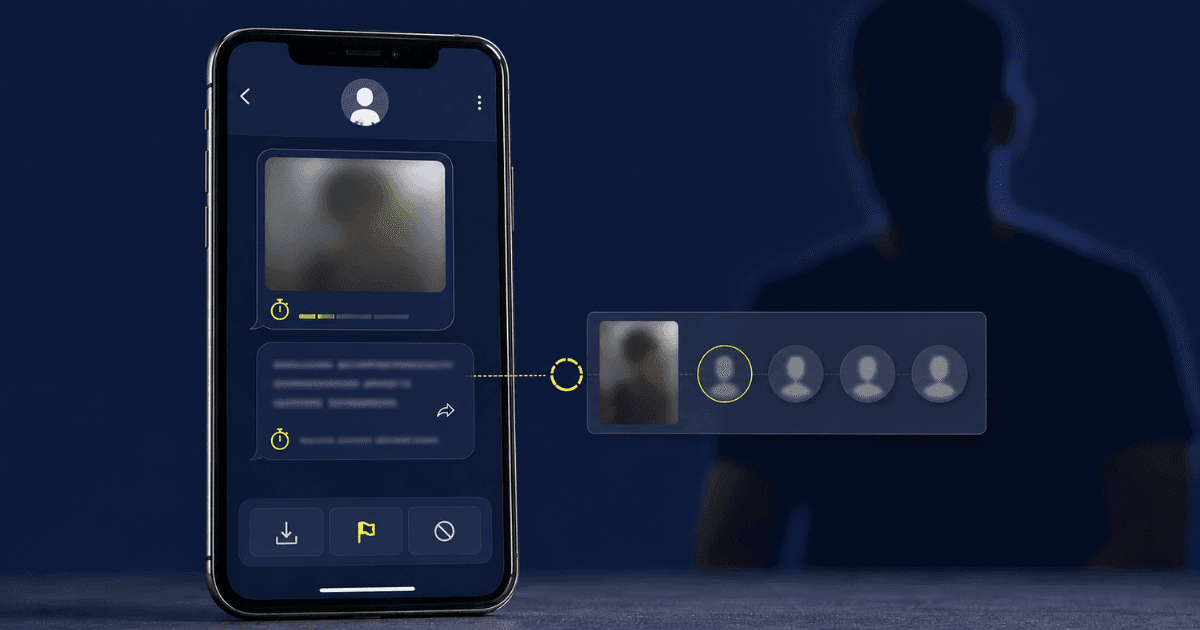
You do not have to wait for an image to appear online to protect it. Free services let you register intimate images so that participating platforms can detect and block them automatically if someone tries to upload them; this is one of the few genuinely proactive steps available, since most other protections only kick in after something has already gone wrong.
StopNCII.org lets adults create a digital fingerprint, called a hash, of an intimate image directly on their own device. The image itself never leaves your phone or computer, and participating platforms use that hash to detect and block matching uploads. Take It Down offers the same kind of hash-based protection and is available for cases involving people who were under 18 when an image was taken.
Because these tools work from a fingerprint rather than the file, they can help stop content from spreading across major platforms before it ever gains an audience. Setting this up early is one of the most effective proactive moves available to you, and it costs nothing but a few minutes, which makes it one of the easiest decisions in this entire process.
Lock down your accounts
Blackmailers often threaten to send images to your specific friends, family, or coworkers. Taking away their map to those people weakens the threat significantly.
- Set your social profiles to private so your follower and friend lists are not visible to strangers.
- Review and remove followers or connections you do not recognize, which are often the blackmailer's own accounts positioned to watch you.
- Tighten who can message you and who can see your posts, tags, and contact details.
- Turn on two-factor authentication everywhere so your accounts cannot be hijacked and used against you.
The harder it is for someone to find and reach the people in your life, the less power a threat to contact them carries. It also helps to sign out of old sessions and disconnect any apps you no longer use, since forgotten logins can be a weak point. These same habits are at the core of sextortion prevention: most successful attacks rely on an account that was easier to reach than it should have been.
Reduce their reach and your exposure
Avoid accepting new friend or follow requests during an active situation, since some are attempts to map your network. If you're worried a specific contact might be targeted, warn that person privately; a short heads-up removes the shock value a blackmailer is counting on. It also helps to search for any existing exposure of your images so nothing is spreading unnoticed. If older private photos are already floating around, removing private photos from the internet generally starts with the same search-and-document approach, regardless of how the images first got out.
Need Expert Help?
Our team has resolved thousands of cases. Get confidential support now.
Exactly What to Do If They Try
Preparation matters most, but you should also know your steps if a blackmailer actually attempts to distribute something. Whether blackmailers send your pictures or not, staying methodical keeps you in control either way. Do not pay and do not negotiate; payment confirms you are reachable and willing, which invites more demands rather than ending them. Preserve the evidence by screenshotting the threats, the profiles, the usernames, and any payment demands, and note the dates and times. This record supports platform reports and any law enforcement involvement.
Report to the platform immediately. Every major service prohibits non-consensual intimate imagery and has a dedicated reporting path, and fast reporting, backed by a pre-registered hash, helps content come down quickly. Stop engaging with the blackmailer once your evidence is saved and your accounts are secured; further conversation only feeds the pressure, and you can block after preserving what you need. If someone is threatening to leak your nudes right now, know that you do not have to manage this alone.
Start Taking Back Control
In the first moments of a threat, it can feel as though the blackmailer holds all the cards. They do not. Their leverage lives entirely in the possibility of exposure, and nearly every step above chips away at that possibility. Registering your images for hash-blocking, locking down your accounts, and knowing your response plan turns a vague, terrifying "what if" into a series of concrete, manageable actions, and each one makes an actual leak less likely, not just less scary to think about.
Whether a blackmailer follows through is ultimately their choice, and there's no way to guarantee whether blackmailers will send your pictures or not, but whether their attempt succeeds is heavily shaped by what you do beforehand. Take the proactive steps, keep your evidence, and if you need to talk it through right now, the blackmail helpline is there for exactly that. Protection is not about hoping the threat goes away, and it never fully depends on whether they follow through. It is about making sure that even if it is tested, you are ready, and that readiness is something you can start building in the next five minutes, not someday.
About the Author
Altahonos Team
The Altahonos Team consists of cybersecurity and online reputation management specialists with extensive experience in digital threat mitigation and content removal strategies, helping individuals and businesses protect their digital presence.
Related Resources
Trusted by Thousands

Based on 488+ verified reviews