

How to Avoid Pure Dating App Scams: Safety Guide
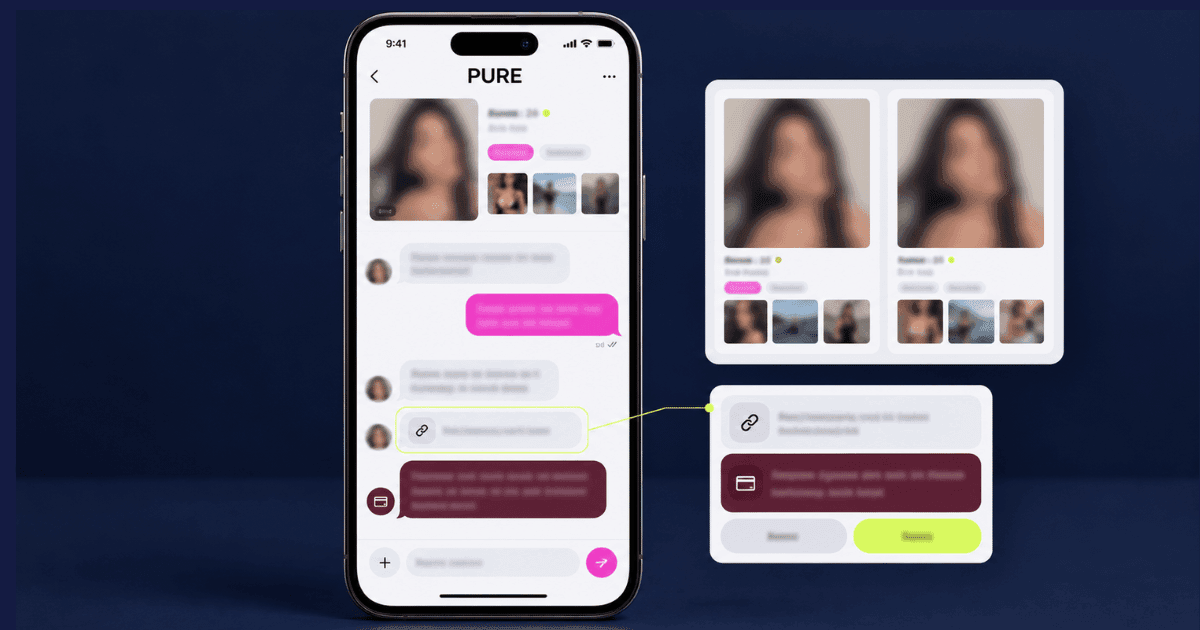
Avoiding Pure dating app scams starts with understanding what makes the platform different: chats disappear, profiles are temporary, and nothing is meant to persist. For people who want discretion, that is a genuine feature. For anyone running a scheme, it is close to ideal, because the same mechanism that protects your privacy also erases the record of what was said to you. That is why this guide takes a slightly different approach from other platforms, one built around keeping your own record and treating the app's short timelines as the pressure device they can become. The signals that work elsewhere, a thin profile or an oddly fast escalation, carry less weight here, so this guide focuses on what actually holds up on Pure specifically.
Why the Format Changes the Risk
Three characteristics shape what happens on this platform.
Disappearing chats. Conversations expire, which means that if something goes wrong you may have no evidence at all unless you captured it while it existed. Scammers rely on this directly, because a report without a conversation attached is difficult to action.
Expiring profiles. Accounts are short lived by design, so an account used for a scheme can be discarded without any of the friction that a long standing profile would create.
An explicitly casual framing. The platform is oriented toward immediate, no strings meetings, which normalises very fast escalation. On a slower app, a conversation moving to intimate content within minutes would stand out. Here it can feel like the intended use.
The outcome is that the warning signs available on other platforms, such as a thin profile history or a strangely quick escalation, carry less diagnostic weight. Spotting Pure dating app scams requires different signals than spotting scams elsewhere.
How Pure Dating App Scams Actually Work
Moving you to another app immediately. Almost every scheme needs the conversation somewhere it controls, and on Pure this request is easy to disguise, because the chat is going to expire anyway. It will be framed as practical. It is the single most important moment in the conversation.
Verification site links. You are told to confirm you are not a bot, or to register on a safety or age verification site before meeting. The site is the scheme: it harvests card details or account credentials. No legitimate dating platform requires you to verify through a third party site introduced by a match.
Intimate content early. Content is requested quickly, often with something sent first. Once it exists, the tone changes and the threats begin. This is where dating app blackmail starts, and the disappearing chat means you may have no record of the conversation that led to it.
The meeting that costs money. A venue is proposed, a deposit or taxi fare is requested in advance, or you arrive and a bill has already been arranged. Any money moving before a meeting is a warning regardless of the reason given.
Keep Your Own Record
This is the specific adaptation this platform requires, and it takes seconds. Screenshot the profile when you match (photos, text, and username), then screenshot the conversation as it progresses, particularly any request to move platforms, any link, and anything about money or content. Save these outside the app; if the conversation moves to another app, keep screenshotting there too, since that is usually where anything actionable happens.
This feels excessive until you need it. A report to the platform, a bank, or the police is vastly more effective with a record attached, and on Pure the record will not exist unless you made it: the platform's disappearing chats protect your privacy from casual exposure, but they remove your evidence at the exact same time, which is precisely why capturing your own record matters more here than on platforms that keep a permanent history.
Need Expert Help?
Our team has resolved thousands of cases. Get confidential support now.
Verify Without Slowing Things Down
Discretion and verification are not in conflict, and the checks that matter here are quick.
Verify Before You Meet
Ask for a short live video call before meeting; on a platform designed around meeting quickly, this is a reasonable request, and it ends most fraudulent conversations immediately. Watch for a call where the person never reacts in real time to something you say, since pre-recorded footage is common. Reverse image search their clearest photo too, since stolen sets tend to appear on other profiles and public accounts under different names.
The Rules That Hold
A short set of rules holds up across almost every scheme on this platform: never send money before meeting for any stated reason, never register on a third party verification site suggested by a match, never send intimate content to someone you have not met in person even when they send first, keep your employer, neighbourhood, and social handles out of early conversation, and stay on the app until a live video call has happened.
Basic Precautions
Meeting in a public place first, telling someone where you're going, and arranging your own transport are ordinary precautions that don't compromise discretion. Treat any link introduced by a match as hostile by default, since a genuine match never needs you to leave the app to prove anything. If a conversation suddenly gets pushy about any of these points, that pressure itself is a signal worth paying attention to.
If Something Has Already Gone Wrong
If you have already sent money or are already being threatened, the priority shifts from prevention to containment, and the steps below apply whether the scheme stayed on Pure or moved elsewhere.
If You Sent Money
Contact your payment provider immediately and keep every record, including the transaction details and the conversation that led to it. Report the transaction rather than waiting to see what happens, since providers are far more likely to intervene the sooner a payment is flagged. File with your local police service as well; even when recovery isn't guaranteed, a formal report creates a record that can matter later.
If You Are Being Threatened Over Content
Stop replying entirely, including refusals. Do not pay, because payment identifies you as someone who pays and typically produces further demands. Capture everything you still have access to, since this is the moment that record becomes useful; knowing how to collect evidence for blackmail helps you preserve the details that may matter when reporting what happened.
Lock Down and Report the Account
Lock down your social accounts and hide your follower lists, since threats to contact people you know depend on those lists being visible. Report the account on Pure and wherever the conversation moved to, then file a police report, even if the chat itself has already expired; the platform still holds account level information, and a report with screenshots attached is far more actionable than one without. Where intimate content is involved, the Cyber Civil Rights Initiative provides support resources for image based abuse.
If Content Has Already Been Shared
If the content has already gone out, speed matters more than anything else: the longer it stays up, the more it gets mirrored and re-shared. Removal and monitoring work across platforms and search results, tracking down re-uploads as they appear rather than stopping after a single takedown, and this is the point where most people find they need more coordinated support than they can manage alone. Understanding how to avoid dating app scams can also help you recognise the same setup earlier if a similar approach happens again on Pure or another platform.
Taking Action Now
Avoiding Pure dating app scams comes down to a few habits: screenshot the profile and conversation as you go, treat a fast push to another app as a reason to slow down, and refuse any third party verification link without exception. Insist on a video call before meeting, meet publicly the first time, and keep money and intimate content out of the conversation until then.
Pure's design gives you real privacy and takes away your paper trail at the same time, and that trade-off is exactly what these schemes count on. Restoring that trail yourself puts you back in a position to act quickly if anything goes wrong. If something already has, getting help with online dating scams can make reporting and recovery easier to manage.
About the Author
Altahonos Team
The Altahonos Team consists of cybersecurity and online reputation management specialists with extensive experience in digital threat mitigation and content removal strategies, helping individuals and businesses protect their digital presence.
Related Resources
Trusted by Thousands

Based on 488+ verified reviews